How Airflow Works With Safari Operators, Travel Agents and Local Experts

For safari operators, travel agents and local experts. Travellers plan their trips on Airflow. Some finish the job themselves. Others want someone who knows the ground to take it over, and that is the partner: you arrange it, bill the traveller and look after them. This post walks through it with our first safari partner, The Safari Vibe, and every step is live for you to try.
The trip we cannot finish for a traveller
A traveller can get a long way on their own. On Airflow they choose a route, decide how many nights to spend at each stop, and look at where they might stay. For a weekend away, that is the whole job.
A ten-day safari is different. Someone has to know which camp is right in February, how the light aircraft connect, what a park fee is this year and who to call when a road washes out. No planner on a website knows that. You do.
So Airflow does not try to arrange these trips. It gets the traveller to the point where they know what they want. From there it depends on whose trip it is:
- A trip the traveller built themselves stays theirs. They can book it on their own, or ask for a partner, and we match the trip to the partner best placed to arrange it: the countries it visits and the kind of trip it is.
- A trip that started from a partner’s own journey goes to that partner by default. They wrote it, so they arrange it.
Meet the example: The Safari Vibe
The Safari Vibe arrange private safaris in Kenya, Tanzania, Botswana, Rwanda, Namibia and Zambia. This is their own website:
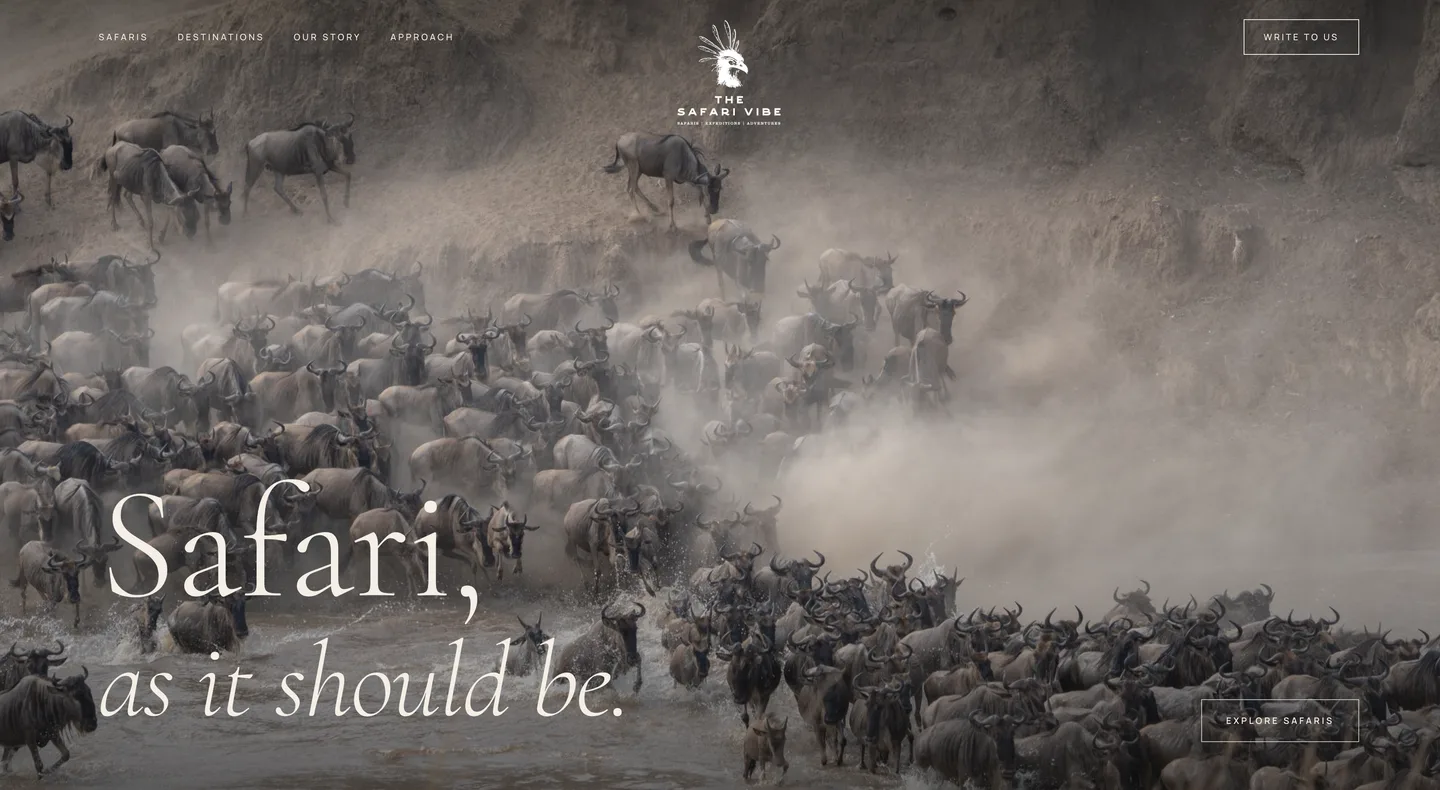
Their page on Airflow Stay is meant to look like theirs. A partner’s page follows the look of their own website: their logo, their typefaces, their colours, their words, in the order their own site tells the story. We built it from their website; they checked it.
Open The Safari Vibe’s page on Airflow Stay
Their journeys become trips a traveller can start
Further down the page are the safaris they have run before.
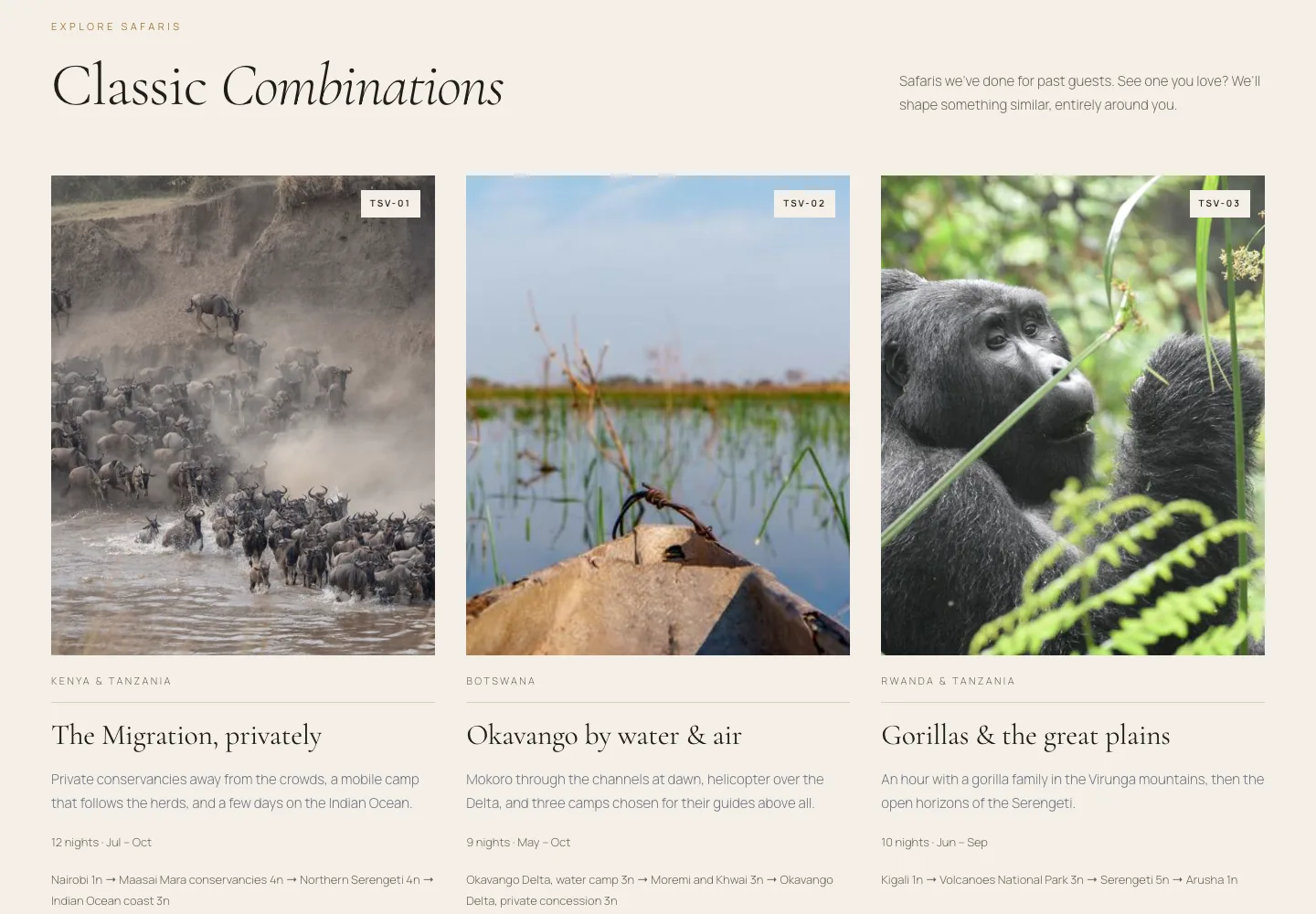
Each one is also a trip in the Airflow trip library, under their name, next to our own trip ideas. It has its stops, the nights at each, and the camps they would choose there. Here is one of them: Rwanda, slowly.
A traveller who starts planning from one of these is planning it with The Safari Vibe from the first click. By default that trip goes to them: it is their journey.
A partner is also shown on our own trip ideas in the countries they cover, so a traveller reading about ten days in northern Tanzania sees who can arrange it. On a trip a traveller put together themselves, nothing is handed to anyone unless they ask.
What the traveller does
The traveller presses Start planning this trip and lands in Airflow Guest, their own planning page, with the route already laid out.
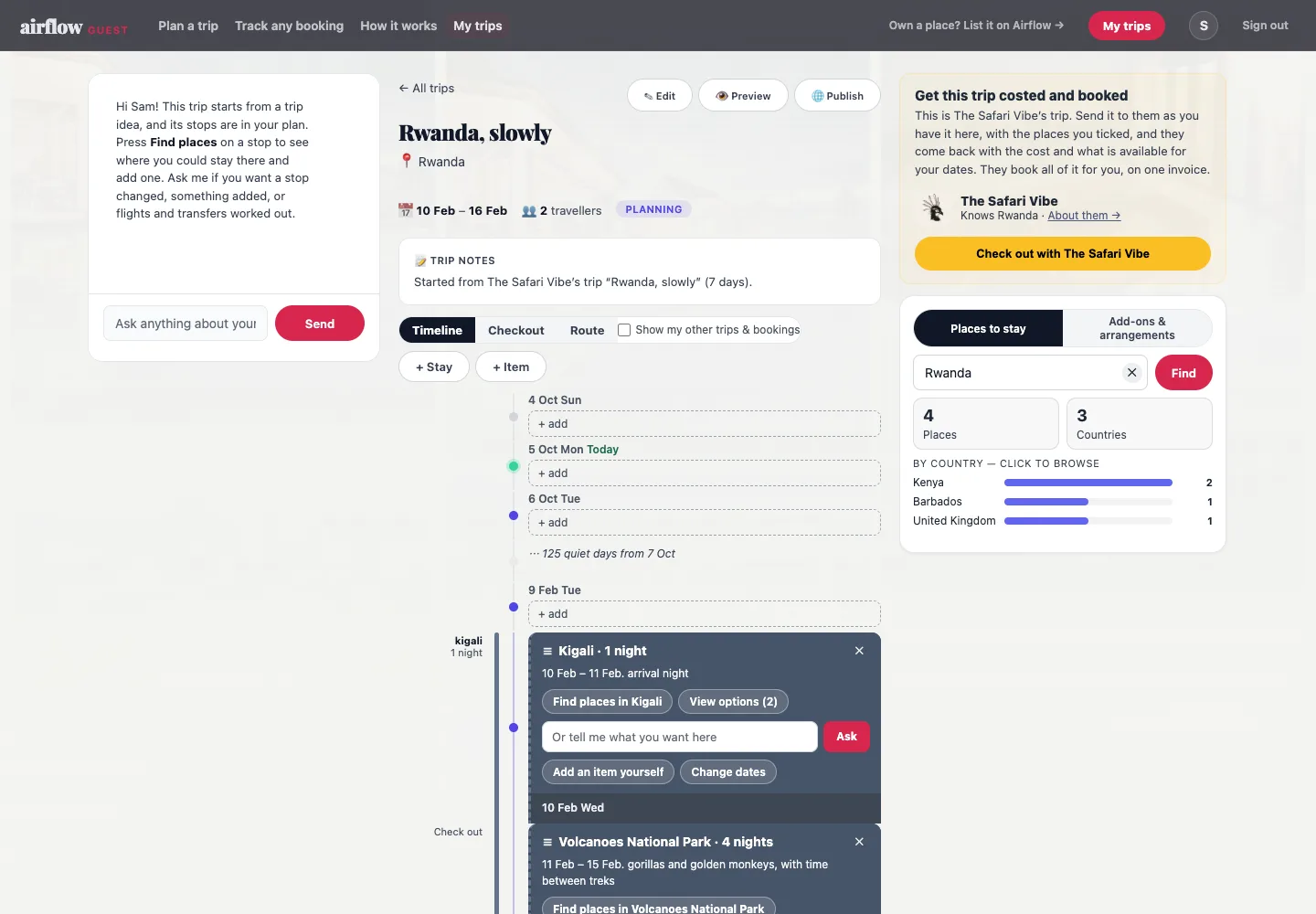
They move the dates and change the number of nights. Anything they have already arranged comes with them: they forward a flight confirmation, or a booking for a stay they made elsewhere, and it lands on the same itinerary. You see the whole trip, not only the part you are arranging.
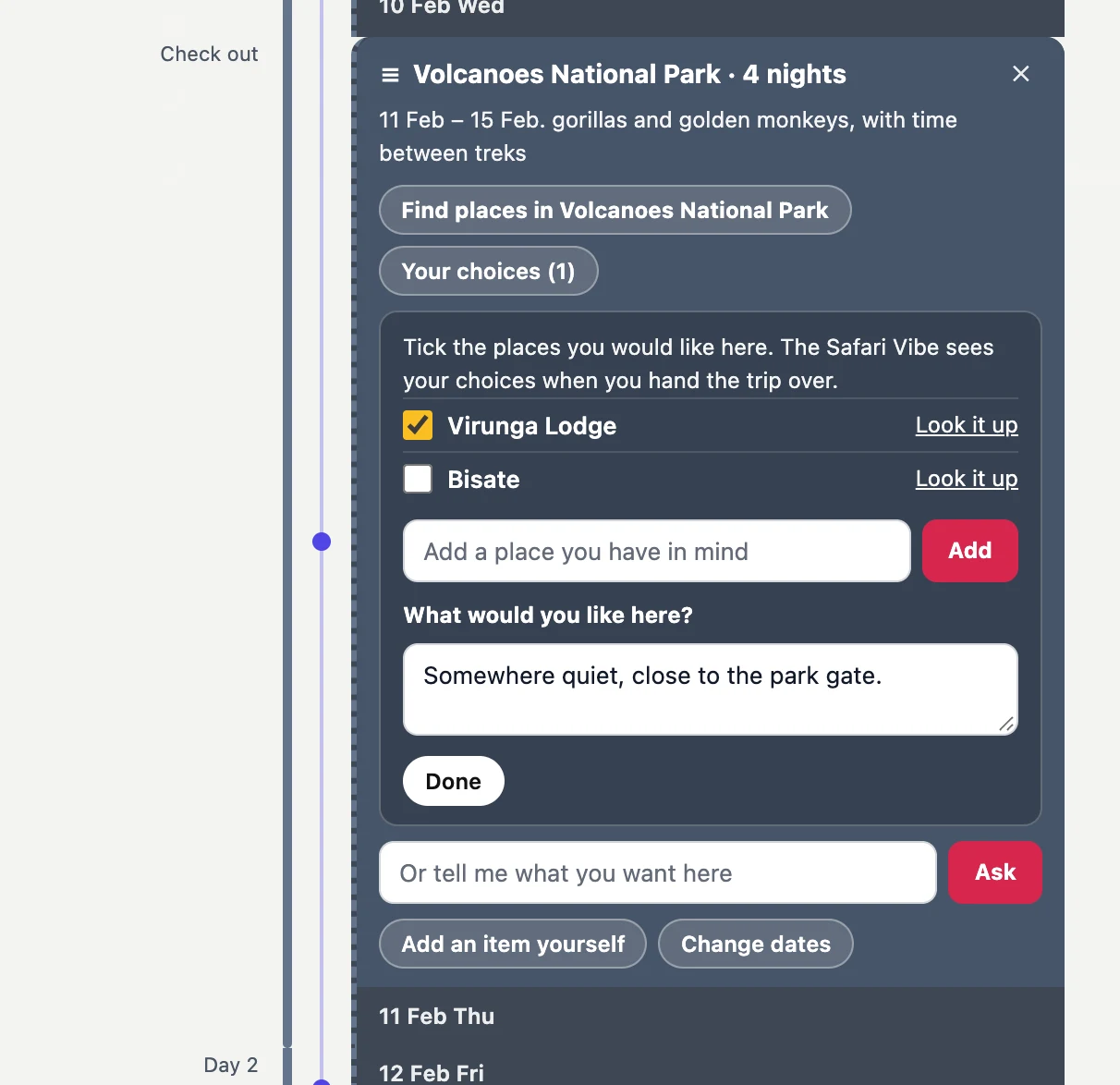
At each stop, View options shows the places the partner suggests. They tick the ones they like, add one they have heard of, and write what matters to them there.
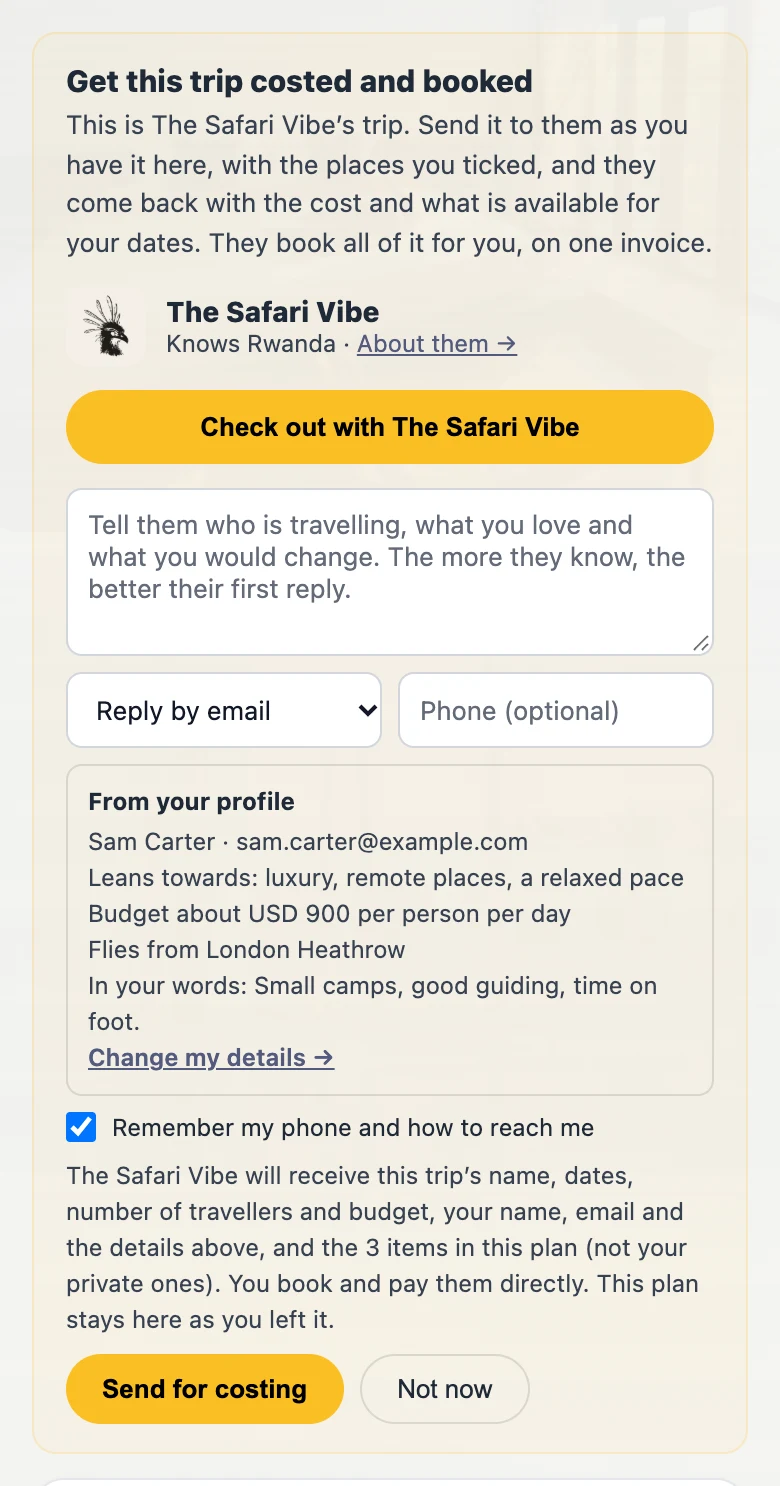
When they are ready, the card on the right of their page is the checkout.
- It names the partner and says plainly what happens next: the trip is sent as it stands, and they come back with the cost and what is available.
- It does not ask them to describe themselves again. Their contact details and how they like to travel are already on their profile.
- They see exactly what will be sent before they send it, and can change it.
- One button sends it: Send for costing.
What arrives in your account
This is the part that is different from an enquiry form.
An enquiry form gives you a name, a month and “we want to see the migration”. You then spend three emails finding out how many people, how long, what budget and what they have already ruled out.
A trip from Airflow arrives with the work done:
- The route, stop by stop, with dates and nights.
- Who is travelling: how many, and whether there are children.
- What they chose: the places they ticked at each stop, and what they wrote about each one.
- How they like to travel: the preferences saved on their profile, their budget per person per day if they gave one, and where they fly from.
- How to reach them: email, phone or WhatsApp, whichever they picked.
- Their own words, if they added a message.
It lands as a trip in your Airflow account, ready to cost. You are told by email the moment it arrives.
You are replying to someone who has already decided to go, knows roughly where, and has asked for you.
Try it yourself
Everything above is live. It takes about five minutes to walk through as a traveller would.
- Open The Safari Vibe’s page and look at how it follows their own site.
- Open one of their journeys, for example Rwanda, slowly, pick a start date and press Start planning this trip.
- Airflow Guest asks for your email so the trip has somewhere to live. The trip opens with its stops in place.
- Press View options on a stop. Tick a lodge and write a line about what you would want there.
- Press Check out with The Safari Vibe to see what would be sent.
Stop there unless you mean it. Send for costing is a real request and a real person will reply.
You run the trip
The traveller comes to you from Airflow. They are our lead, and that is what the commission is for: the trip you arrange for them, and the trips they book with you afterwards. The trip itself is yours to run.
- You cost the trip in your account, leg by leg: camps, guides, flights, transfers.
- You bill the traveller, on one invoice. Directly, in your own name, or through Airflow if you would rather we take the payment.
- The itinerary and what has been paid stay in one place that you and the traveller can both see.
- The traveller keeps their trip page. It is where they follow the plan before they go and while they are away, and where they start the next one.
Airflow does not contact the camps and lodges you name on your journeys. Those relationships are yours.
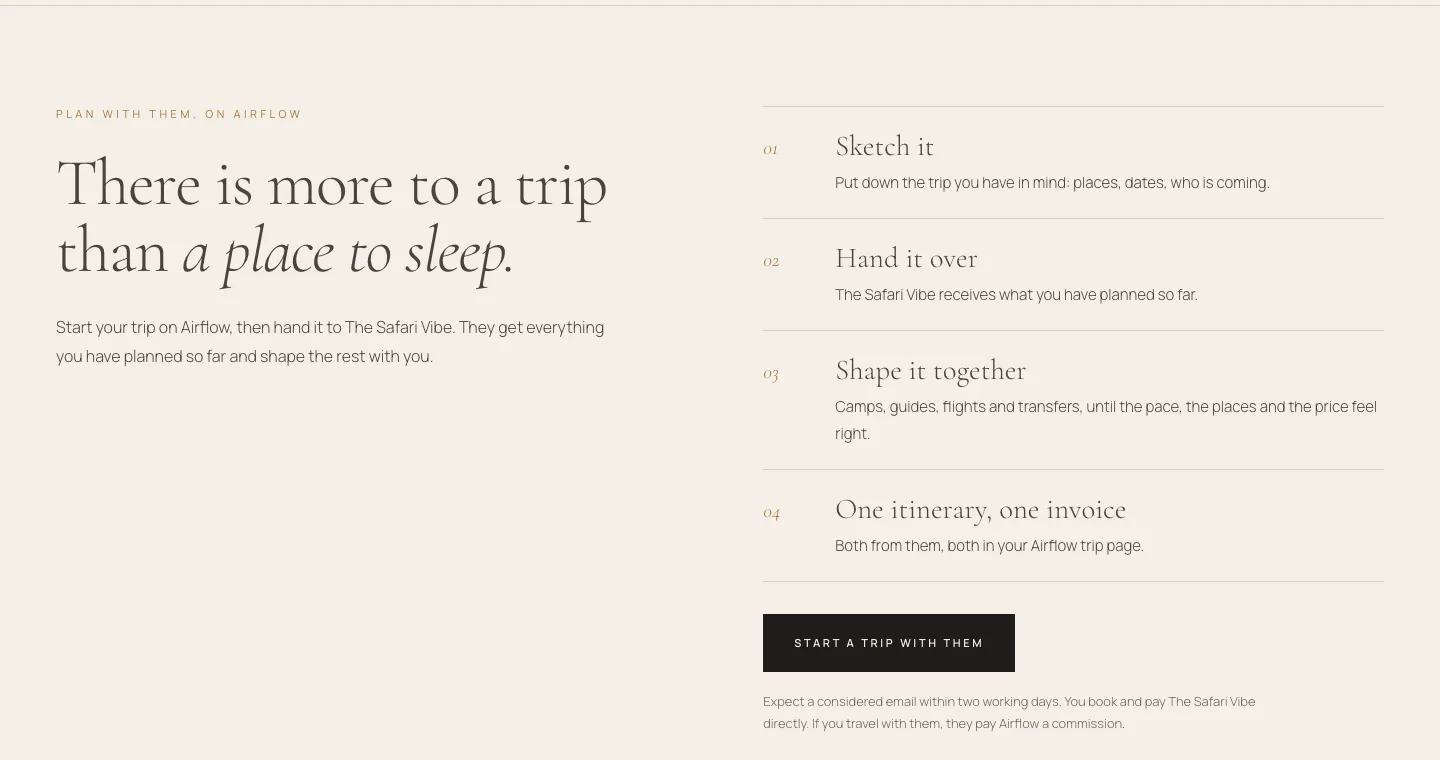
The Safari Vibe’s own page says it to travellers in four lines:
What it costs
There is no fee to join, no listing fee and no subscription.
You pay a commission on trips that come to you from Airflow, including later trips by the same traveller. The rate is agreed with you before you start and written into your agreement. You choose to pay it by card or by bank transfer. A trip you bring to Airflow yourself, for a client of your own, carries no commission.
If Airflow sends you nothing, you pay nothing.
A partner account is a full Airflow account, so you can take it further when you want to. Like any business on Airflow, you can move to a plan that switches on more automation and the accounting connections, or launch your own website on Airflow with your trips and places on it.
Add your own places
If you own or manage camps, lodges, villas or boats, list them on Airflow as well.
- They are offered on your journeys. At each stop, the places you name are what the traveller chooses between. Your own can be among them.
- They take direct bookings. A listing has its own booking page, calendar and payments, for the guests who are not on a planned trip at all.
- They are found on their own. A place on Airflow Stay is shown to travellers looking in that area, whoever is arranging their trip.
- You can write itineraries around them. A host can put forward a route with their own place at one of the stops and the extras they offer there.
Airflow Stay is still being filled before its search opens to travellers. Places listed now are there from the first day.
You do not need a second account. Your partner page, your trips and your listings all sit in one place.
What we ask of a partner
Not much, but it matters.
- Answer the traveller. They have chosen you and are waiting. A first reply within a day or two is what keeps a trip alive.
- Keep your page true. The journeys and places on it should be ones you would arrange tomorrow.
- Record what the traveller pays you on the trip, so the commission is worked out on real figures.
We keep the number of partners in each region small on purpose. A traveller should be handed to someone who will pick up the trip, not to a list.
How to become a partner
- Apply. The form takes about two minutes and asks where you work and what kinds of trip you arrange. A person reads every application and replies.
- Agree terms. We send your agreement with your commission. You agree online and choose how you will pay it.
- We set you up. We build your account and your page, starting from your own website, the way we did for The Safari Vibe. You check it, then we switch it on.
Apply to be an Airflow partner
Have places of your own? List a place on Airflow Stay and it can be offered on your journeys from the start.